Let's Get
Started
Let us show you how Omada can enable your business.


A definite guide to Identity Governance and
Administration best practices. Learn how to
successfully deploy and maintain an IGA solution.

Our comprehensive Identity and Cybersecurity
glossary, featuring extensive explanations, real-life
examples, practical frameworks and everything else
you need to understand key concepts in identity and
cybersecurity.

In this Guide, Gartner has identified Omada as a
Representative Vendor in IGA. Use it to evaluate top
Identity Governance vendors and anticipate future
trends, features, and capabilities in the IGA market.

Familiarize yourself with the typical threats that
can derail a seamless legacy to cloud migration of
IGA functionality and get tips on managing them.
As part of their digital transformation, DEKRA moved
from an in-house access management solution to
a modern, cloud based Omada IGA solution.
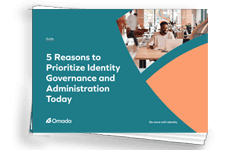
Get practical examples and data proving the
value of IGA and learn the five key reasons you
must make it a business imperative today.

Explore our white papers on compliance, security, and
efficiency topics. Gain insights and best practices to drive
informed decisions and enhance your organizational strategy.

We are constantly adding new features to Omada
products to ensure your IGA efforts keep pace with
the ever-evolving threat landscape.

Get information about the newest Omada product
features, benefits, and use cases to ensure you get
the most from your IGA program.

Participate in interactive product demos covering
capabilities such as Delegate Access, Request
Access, Approve Access Request, and more.

Get the latest IGA trends, information, and intelligence
from renowned industry experts in Omada’s live and
on-demand webinar presentations.

A market-leading provider of identity governance
and administration solutions. Get to know us better!

At Omada, efficient teamwork creates extraordinary results.
We enable talented people to create career paths where
they can thrive, be inspired, and have fun.

Omada partners provide unmatched advisory, product
and service re-sale, and project delivery resulting in
unsurpassed customer satisfaction scores.

Don’t just take our word about the value of Omada
solutions. See what actual users think.

See what the media are reporting about our
innovative identity governance solutions.

We frequently deliver expert presentations, exhibit, and
run demos at the world’s leading security and IGA events.
Look at our upcoming schedule to see if we cross paths –
we'd love to speak with you.
Omada is a winner for a third consecutive year in the 7th
annual CyberSecurity Breakthrough Awards program.

Omada is a global market leader in Identity Governance.
Please reach out to us with questions or to get more information.

Find here legal documents governing and relating to the
provisioning of Omada Offerings - Customer Agreement, DPA, and more.
A definite guide to Identity Governance and
Administration best practices. Learn how to
successfully deploy and maintain an IGA solution.
Our comprehensive Identity and Cybersecurity
glossary, featuring extensive explanations, real-life
examples, practical frameworks and everything else
you need to understand key concepts in identity and
cybersecurity.
In this Guide, Gartner has identified Omada as a
Representative Vendor in IGA. Use it to evaluate top
Identity Governance vendors and anticipate future
trends, features, and capabilities in the IGA market.
Familiarize yourself with the typical threats that
can derail a seamless legacy to cloud migration of
IGA functionality and get tips on managing them.
As part of their digital transformation, DEKRA moved
from an in-house access management solution to
a modern, cloud based Omada IGA solution.
Get practical examples and data proving the
value of IGA and learn the five key reasons you
must make it a business imperative today.
Explore our white papers on compliance, security, and
efficiency topics. Gain insights and best practices to drive
informed decisions and enhance your organizational strategy.
We are constantly adding new features to Omada
products to ensure your IGA efforts keep pace with
the ever-evolving threat landscape.
Get information about the newest Omada product
features, benefits, and use cases to ensure you get
the most from your IGA program.
Participate in interactive product demos covering
capabilities such as Delegate Access, Request
Access, Approve Access Request, and more.
Get the latest IGA trends, information, and intelligence
from renowned industry experts in Omada’s live and
on-demand webinar presentations.
A market-leading provider of identity governance
and administration solutions. Get to know us better!
At Omada, efficient teamwork creates extraordinary results.
We enable talented people to create career paths where
they can thrive, be inspired, and have fun.
Omada partners provide unmatched advisory, product
and service re-sale, and project delivery resulting in
unsurpassed customer satisfaction scores.
Don’t just take our word about the value of Omada
solutions. See what actual users think.
See what the media are reporting about our
innovative identity governance solutions.
We frequently deliver expert presentations, exhibit, and
run demos at the world’s leading security and IGA events.
Look at our upcoming schedule to see if we cross paths –
we'd love to speak with you.
Omada is a winner for a third consecutive year in the 7th
annual CyberSecurity Breakthrough Awards program.
Omada is a global market leader in Identity Governance.
Please reach out to us with questions or to get more information.
Find here legal documents governing and relating to the
provisioning of Omada Offerings - Customer Agreement, DPA, and more.


Artificial intelligence agents, bots, and services are joining the workforce as non-human identities, expanding the attack surface. The article argues for a modern Identity Governance and Administration (IGA) model that can grant, monitor, and attest their access while sharing context across tools to keep adoption safe.
The conversation about AI agent access management has taken a decisive turn. As intelligent systems grow more autonomous, the tension between innovation and control becomes palpable. Enterprises now find themselves contending not just with human users, but with sophisticated AI agents that can navigate digital ecosystems, collaborate with each other, and act on a user’s behalf. The new frontier of identity demands more than just simple authentication; it calls for a governance framework that can adapt to a world where agents represent people, processes, and entire business units.
The traditional scope of identity and access management (IAM) once revolved around well-understood roles and users. Modern identity governance and administration (IGA) tools must now accommodate a growing class of entities that don’t neatly fit the legacy model. AI agents can perform tasks like scheduling meetings, updating sales pipelines, analyzing code repositories, and retrieving sensitive documents. As these agents interact with cloud services, corporate resources, and each other, the enterprise’s identity fabric must ensure that only authorized and properly credentialed agents gain access to the right data and workflows.
The industry as a whole has seen emerging voices, about the need to address the identity challenges posed by AI agents.
There is a highlighted and important need to verify agents and their entitlements, ensuring that each one only access what it is meant to. This is a critical step, but as more solutions come to market, enterprises need to think beyond simply assigning credentials to AI agents.
There is a critical need to verify agents, ensuring that each one only has access to what it is intended for.
A key aspect of agent-based ecosystems lies in managing the nuances of authorization. Consider a scenario:
Granting broad access to all these resources and data sets indiscriminately is untenable. If an agent specialized in investments also gained access to calendar details or source code repositories, it could result in unintended leakage of proprietary information or regulatory compliance failures. The crux of the problem goes beyond just verifying an agent’s identity; it centers on dynamically controlling what each agent is authorized to do in a constantly shifting environment.
This complex orchestration of identities—human and non-human—calls for a new approach. Modern IGA technologies introduce granular policy management, lifecycle automation, and advanced authorization workflows. They bring together the intelligence needed to define and enforce rules across a spectrum of entities, including AI agents. An effective IGA solution must integrate seamlessly with cutting-edge AI frameworks and generative models, ensuring that trust boundaries and permissions remain intact as agents scale.
At Omada, our focus is on strengthening your enterprise’s overall identity posture. By integrating with foundational IAM technologies and adding advanced governance capabilities, Omada’s IGA solution plays a critical role in this process. The goal is to ensure that regardless of how widespread and autonomous AI agents become, they operate within clearly defined guardrails. This includes the ability to:
The strategic importance of robust identity governance becomes more evident when considering market forecasts. According to Research and Markets, the AI agents’ market is projected to grow from $5.1 billion in 2024 to $47.1 billion in 2030, indicating a 44.8% CAGR during that period1. This explosive growth suggests that organizations will soon rely on AI agents for critical decisions and operations, intensifying the need for enterprise-grade identity governance.
LangChain’s recent survey of over 1,300 professionals found that 51% are already using AI agents in production, and 63% of mid-sized companies have them running live workloads2. As more enterprises plan to integrate AI agents, careful consideration of identity and governance models will determine whether these initiatives thrive or flounder.
The challenge is clear: AI agents deliver speed, scale, and innovation, but these benefits come at the cost of complexity in identity management. The solution demands a lens that goes beyond credentials and simple OAuth flows. It calls for a governance framework capable of orchestrating dynamic policies, automating approval processes, and managing the full lifecycle of AI agent identities just as thoroughly as human ones.
By embracing a modern IGA approach, organizations ensure that as they adopt new frameworks, integrate with large language models, and build agentic systems, they do so responsibly. The conversation must shift from the baseline of “Can we identify and authenticate an agent?” to the more nuanced and ultimately more impactful question: “How do we govern the complex tapestry of AI agent identities and permissions so that businesses remain both agile and secure?”
The future of identity management rests on our ability to solve this puzzle. With the right governance tools, frameworks, and strategies, enterprises can embrace the potential of AI agents without compromising on trust, security, or accountability.

FREQUENTLY ASKED QUESTIONS
Artificial intelligence agents, bots, and services are emerging as non human identities that use corporate resources. These agents can schedule meetings, update sales data, analyze code, and retrieve sensitive documents, which expands both the identity fabric and the attack surface that identity teams must govern.
AI agents specialize in tasks such as calendaring, investment management, or code handling, and each activity touches different sensitive data. Granting broad access to many data sets is not sustainable, so organizations need dynamic and fine grained control over what each agent can do in a changing environment.
Modern Identity Governance and Administration (IGA) should provide granular policy management, lifecycle automation, and advanced authorization workflows for both human and non human identities. Effective solutions integrate with AI frameworks, assign and revoke permissions dynamically, monitor agent activity, and maintain audit trails that meet compliance and internal governance standards.
Adoption of AI agents is growing quickly as organizations deploy them to support critical operations and decision making. As reliance on these agents increases, thoughtful governance becomes essential to ensure they deliver value without undermining trust, security, or accountability in the wider environment.
The main goal is to move beyond simple identification and authentication and toward a framework that governs the full lifecycle of AI agent identities and permissions. With clear policies and tools, enterprises can benefit from speed and scale while keeping agents within defined guardrails that protect business interests.