Standardized AI-to-identity connectivity
MCP defines a single communication standard for AI agents. You integrate once with an MCP layer instead of building custom links to every system that holds identity and access data.


A definite guide to Identity Governance and
Administration best practices. Learn how to
successfully deploy and maintain an IGA solution.

Our comprehensive Identity and Cybersecurity
glossary, featuring extensive explanations, real-life
examples, practical frameworks and everything else
you need to understand key concepts in identity and
cybersecurity.

In this Guide, Gartner has identified Omada as a
Representative Vendor in IGA. Use it to evaluate top
Identity Governance vendors and anticipate future
trends, features, and capabilities in the IGA market.

Familiarize yourself with the typical threats that
can derail a seamless legacy to cloud migration of
IGA functionality and get tips on managing them.
As part of their digital transformation, DEKRA moved
from an in-house access management solution to
a modern, cloud based Omada IGA solution.
Get practical examples and data proving the
value of IGA and learn the five key reasons you
must make it a business imperative today.

Explore our white papers on compliance, security, and
efficiency topics. Gain insights and best practices to drive
informed decisions and enhance your organizational strategy.

We are constantly adding new features to Omada
products to ensure your IGA efforts keep pace with
the ever-evolving threat landscape.

Get information about the newest Omada product
features, benefits, and use cases to ensure you get
the most from your IGA program.

Get the latest IGA trends, information, and intelligence
from renowned industry experts in Omada’s live and
on-demand webinar presentations.

A market-leading provider of identity governance
and administration solutions. Get to know us better!

At Omada, efficient teamwork creates extraordinary results.
We enable talented people to create career paths where
they can thrive, be inspired, and have fun.

Omada partners provide unmatched advisory, product
and service re-sale, and project delivery resulting in
unsurpassed customer satisfaction scores.
Don’t just take our word about the value of Omada
solutions. See what actual users think.

See what the media are reporting about our
innovative identity governance solutions.

We frequently deliver expert presentations, exhibit, and
run demos at the world’s leading security and IGA events.
Look at our upcoming schedule to see if we cross paths –
we'd love to speak with you.
Omada is a winner for a third consecutive year in the 7th
annual CyberSecurity Breakthrough Awards program.

Omada is a global market leader in Identity Governance.
Please reach out to us with questions or to get more information.

Find here legal documents governing and relating to the
provisioning of Omada Offerings - Customer Agreement, DPA, and more.
A definite guide to Identity Governance and
Administration best practices. Learn how to
successfully deploy and maintain an IGA solution.
Our comprehensive Identity and Cybersecurity
glossary, featuring extensive explanations, real-life
examples, practical frameworks and everything else
you need to understand key concepts in identity and
cybersecurity.
In this Guide, Gartner has identified Omada as a
Representative Vendor in IGA. Use it to evaluate top
Identity Governance vendors and anticipate future
trends, features, and capabilities in the IGA market.
Familiarize yourself with the typical threats that
can derail a seamless legacy to cloud migration of
IGA functionality and get tips on managing them.
As part of their digital transformation, DEKRA moved
from an in-house access management solution to
a modern, cloud based Omada IGA solution.
Get practical examples and data proving the
value of IGA and learn the five key reasons you
must make it a business imperative today.
Explore our white papers on compliance, security, and
efficiency topics. Gain insights and best practices to drive
informed decisions and enhance your organizational strategy.
We are constantly adding new features to Omada
products to ensure your IGA efforts keep pace with
the ever-evolving threat landscape.
Get information about the newest Omada product
features, benefits, and use cases to ensure you get
the most from your IGA program.
Get the latest IGA trends, information, and intelligence
from renowned industry experts in Omada’s live and
on-demand webinar presentations.
A market-leading provider of identity governance
and administration solutions. Get to know us better!
At Omada, efficient teamwork creates extraordinary results.
We enable talented people to create career paths where
they can thrive, be inspired, and have fun.
Omada partners provide unmatched advisory, product
and service re-sale, and project delivery resulting in
unsurpassed customer satisfaction scores.
Don’t just take our word about the value of Omada
solutions. See what actual users think.
See what the media are reporting about our
innovative identity governance solutions.
We frequently deliver expert presentations, exhibit, and
run demos at the world’s leading security and IGA events.
Look at our upcoming schedule to see if we cross paths –
we'd love to speak with you.
Omada is a winner for a third consecutive year in the 7th
annual CyberSecurity Breakthrough Awards program.
Omada is a global market leader in Identity Governance.
Please reach out to us with questions or to get more information.
Find here legal documents governing and relating to the
provisioning of Omada Offerings - Customer Agreement, DPA, and more.


AI-ready connectivity for identity-first enterprises
Enterprises are now deploying AI assistants and autonomous agents into real workflows, where they must query systems, request access, and take action on behalf of users. Without a standard interface, every integration becomes a custom project with its own security gaps, and every agent becomes an ungoverned actor in your environment. To bring these agents under consistent control, enterprises need a common way for AI to interact with governed systems.
The Model Context Protocol (MCP) defines that common interface. MCP is an open standard that defines a common way for AI agents to connect to enterprise systems. Instead of custom plug-ins and point integrations, AI works through a single, structured interface that is easier to secure and govern. For identity governance, MCP creates the foundation for two related capabilities: AI that supports IGA, and IGA that governs AI.
MCP defines a single communication standard for AI agents. You integrate once with an MCP layer instead of building custom links to every system that holds identity and access data.
MCP carries structured requests from AI agents into Omada, where policies, SoD rules, risk models, and approvals are applied before any identity-related change is made in enterprise systems.
Omada treats AI agents as identities with owners, roles, and lifecycles. MCP activity becomes input for governance, allowing Omada to monitor, constrain, and certify how agents use tools and data across the estate.
Enterprises rely on many operational systems, each with different APIs and data models. MCP defines a single communication standard for AI agents, so you integrate once with an enterprise MCP layer instead of building custom links to every system. Through that layer, the agent can create tickets, request access, or look up user information via one consistent interface, while MCP manages translation, routing, and security in the background.
MCP introduces a single integration layer between AI agents and enterprise systems. The agent connects once to the Enterprise MCP Layer, which routes requests through dedicated MCP servers to backend platforms like ITSM, ERP, CRM, and identity governance. Behind the MCP layer, dedicated MCP servers sit in front of your core platforms. Each server exposes MCP tools representing specific queries and actions. The AI agent invokes these tools in a uniform way, while each MCP server translates them into native API calls and manages secure connections to the underlying enterprise systems. This decouples AI capabilities from system complexity and makes integrations more stable and easier to govern.
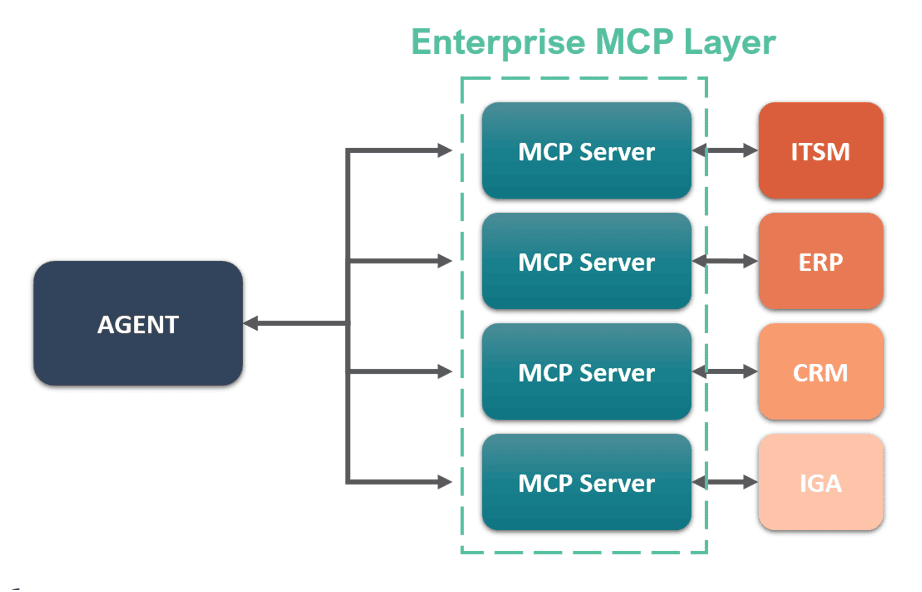
A manager asks an AI agent, “Give Maria temporary finance access and track for audit.” The assistant, acting as an MCP client, sends a single request into the enterprise MCP layer. MCP first uses Omada Identity Cloud to find the correct “Maria”, check her existing access, and evaluate policy and risk. If the request is allowed, MCP then calls the finance MCP server to assign the temporary role and the ITSM MCP server to create a change ticket that records the request, the action, and the expiry. One natural-language request results in coordinated changes across multiple governed systems, with a complete audit trail.
MCP defines how AI agents reach your enterprise systems. Identity governance defines what they are allowed to do when they get there. MCP carries structured requests into your environment, and Omada Identity Cloud evaluates them through its policy engine, SoD controls, risk models, and business workflows. MCP handles connectivity; Omada acts as the control plane that decides which AI-initiated actions are safe and aligned with policy.
When an AI agent submits a request to look up a user, grant access, or remove a role, it flows through the enterprise MCP layer under a governed identity managed in Omada. That identity carries only required permissions and can be fully lifecycle-managed. Omada interprets each request in a business context, checking policies, risk scores, and approval chains before any change is made in downstream enterprise systems.
MCP and Omada both record their part of the transaction. MCP logs which agent invoked which tool. Omada records the governance decision and exact changes to identities and entitlements. Correlating these views gives security and audit teams a single place to trace AI-driven activity from query to system change.
The same foundation enables IGA for AI. Omada treats AI agents as identities with owners, roles, and lifecycle states so they can be governed alongside humans. Policies define which MCP tools an agent is allowed to use, on whose behalf, and under what conditions. As activity flows through MCP, it becomes a rich signal for analytics and future controls that help organizations detect agents that call unexpected tools, operate outside acceptable risk thresholds, or accumulate excessive access.
This establishes the basis for a continuous governance loop. AI agents can rely on Omada, via MCP, when they need to access or act on identity data. In turn, that activity becomes input to how Omada observes and shapes agent behavior over time. Identity governance is evolving into the control plane for both human and AI-driven activity, helping ensure agentic operations stay within clear, auditable policy boundaries.
The Omada MCP Server provides a standardized, secure way to connect with AI assistants, automation tools, and other enterprise systems. To receive access to the Omada Identity MCP Server GitHub project, contact your Omada customer representative or the Omada Support Desk.
FEATURED RESOURCES

Omada’s MCP Server implementation represents an early milestone in the evolution from AI for IGA toward IGA for AI, and focuses on using AI to extend and simplify governance capabilities today.
This guide aims to inform organizations how to successfully deploy and maintain an identity governance solution and realize the security, compliance, and efficiency benefits needed to run their business.
Discover how Omada Identity Cloud accelerates secure identity management with AI-driven insights, fast deployment, and built-in best practices for lasting compliance.