
Security
A prerequisite for both to ensure transparency and control of exactly who’s allowed to access what and when.


A definite guide to Identity Governance and
Administration best practices. Learn how to
successfully deploy and maintain an IGA solution.
As part of their digital transformation, DEKRA moved
from an in-house access management solution to
a modern, cloud based Omada IGA solution.

In this year’s report, Omada was once again recognized as an Overall Leader.

Get the latest IGA trends, information, and intelligence
from renowned industry experts in Omada’s live and
on-demand webinar presentations.

Familiarize yourself with the typical threats that
can derail a seamless legacy to cloud migration of
IGA functionality and get tips on managing them.
Get practical examples and data proving the
value of IGA and learn the five key reasons you
must make it a business imperative today.

We are constantly adding new features to Omada
products to ensure your IGA efforts keep pace with
the ever-evolving threat landscape.

Explore our white papers on compliance, security, and
efficiency topics. Gain insights and best practices to drive
informed decisions and enhance your organizational strategy.

Get information about the newest Omada product
features, benefits, and use cases to ensure you get
the most from your IGA program.

Our comprehensive Identity and Cybersecurity
glossary, featuring extensive explanations, real-life
examples, practical frameworks and everything else
you need to understand key concepts in identity and
cybersecurity.

A market-leading provider of identity governance
and administration solutions. Get to know us better!

At Omada, efficient teamwork creates extraordinary results.
We enable talented people to create career paths where
they can thrive, be inspired, and have fun.

Omada partners provide unmatched advisory, product
and service re-sale, and project delivery resulting in
unsurpassed customer satisfaction scores.

Don’t just take our word about the value of Omada
solutions. See what actual users think.

We frequently deliver expert presentations, exhibit, and
run demos at the world’s leading security and IGA events.
Look at our upcoming schedule to see if we cross paths –
we'd love to speak with you.

See what the media are reporting about our
innovative identity governance solutions.

Explore our official press releases on identity governance, product launches, and company milestones.

Find here legal documents governing and relating to the
provisioning of Omada Offerings - Customer Agreement, DPA, and more.

Omada is a global market leader in Identity Governance.
Please reach out to us with questions or to get more information.
A definite guide to Identity Governance and
Administration best practices. Learn how to
successfully deploy and maintain an IGA solution.
As part of their digital transformation, DEKRA moved
from an in-house access management solution to
a modern, cloud based Omada IGA solution.
In this year’s report, Omada was once again recognized as an Overall Leader.
Get the latest IGA trends, information, and intelligence
from renowned industry experts in Omada’s live and
on-demand webinar presentations.
Familiarize yourself with the typical threats that
can derail a seamless legacy to cloud migration of
IGA functionality and get tips on managing them.
Get practical examples and data proving the
value of IGA and learn the five key reasons you
must make it a business imperative today.
We are constantly adding new features to Omada
products to ensure your IGA efforts keep pace with
the ever-evolving threat landscape.
Explore our white papers on compliance, security, and
efficiency topics. Gain insights and best practices to drive
informed decisions and enhance your organizational strategy.
Get information about the newest Omada product
features, benefits, and use cases to ensure you get
the most from your IGA program.
Our comprehensive Identity and Cybersecurity
glossary, featuring extensive explanations, real-life
examples, practical frameworks and everything else
you need to understand key concepts in identity and
cybersecurity.
A market-leading provider of identity governance
and administration solutions. Get to know us better!
At Omada, efficient teamwork creates extraordinary results.
We enable talented people to create career paths where
they can thrive, be inspired, and have fun.
Omada partners provide unmatched advisory, product
and service re-sale, and project delivery resulting in
unsurpassed customer satisfaction scores.
Don’t just take our word about the value of Omada
solutions. See what actual users think.
We frequently deliver expert presentations, exhibit, and
run demos at the world’s leading security and IGA events.
Look at our upcoming schedule to see if we cross paths –
we'd love to speak with you.
See what the media are reporting about our
innovative identity governance solutions.
Explore our official press releases on identity governance, product launches, and company milestones.
Find here legal documents governing and relating to the
provisioning of Omada Offerings - Customer Agreement, DPA, and more.
Omada is a global market leader in Identity Governance.
Please reach out to us with questions or to get more information.


Omada meets your security, compliance, and efficiency needs, removing cost and uncertainty from managing identities and access
A prerequisite for both to ensure transparency and control of exactly who’s allowed to access what and when.

The key driver for regulated industries who need to document compliance for authorities and auditors.

The key driver for non-regulated industries who need to onboard applications and ensure timely access to a large number of identities.

The move towards cloud applications, M&As, and remote working, in addition to continuous requirements from the business to onboard new applications are key challenges for many organizations – how to maintain control, manage risk, and ensure compliance without restraining business efficiency and collaboration. With the acceleration of digitalization, IT departments are facing an ever increasing workload, where it becomes harder to keep track of compliance and stay in control of security requirements.
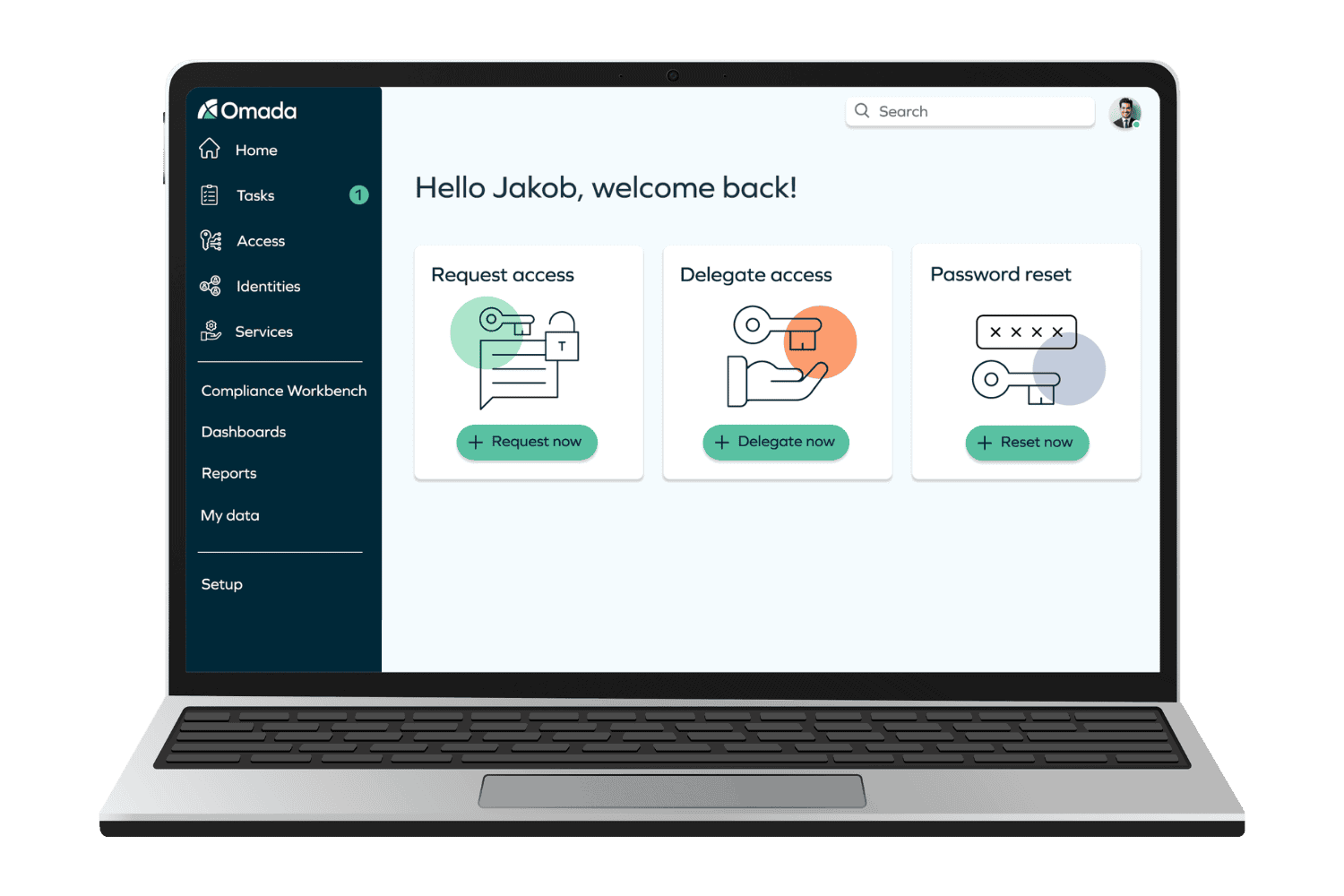
Modern identity and access governance solutions are based on zero-trust security principles, but also provide an automated implementation of business workflows and processes that enable efficiency, such as automated provisioning, self-service access requests, and approvals.
Omada is the leading IGA solution trusted by top enterprises and organizations around the globe. We help clients scale their operations while ensuring all security, compliance, and efficiency needs are met. With support for either onsite implementation or as a software-as-a-service (SaaS) platform, Omada is a flexible and future-ready IGA service.
Frequently asked questions
Identity governance and administration solutions (IGA) are policy-based approaches to identity access management across an entire organization. It enables security professionals and system administrators to automate user access to minimize the risks of hacks and breaches.
An IGA solution combines two distinct capabilities – identity governance and identity administration – into one unified platform. This allows for easier management through a single centralized location.
Identity governance deals with the role and associated policies of each user in the organization. It enables administrators and security and risk management leaders to define who has access to what in a network. Identity governance also involves processes that deal with policy violations and compliance requirements.
Identity administration involves managing user access in the network. Its tasks include device provisioning, entitlement management, and account administration. Identity administration aims to link users to the application data they need quickly and safely.
An IGA solution is crucial for organizations with hybrid (cloud and onsite) networks where thousands of users and devices connect simultaneously. This is especially important for networks that scale rapidly.
In these cases, IGA software provides the necessary automation to manage such a volume at scale when manual methods are impossible. At the same time, it ensures that the network’s efficiency and productivity aren’t sacrificed.
Identity and access management (IAM) is the umbrella discipline focused on making sure every user and non-human identity (NHI) in your environment has access to the right resources at the right time and for the right business reasons. IAM spans multiple capability areas, including authentication, single sign-on, privileged access management (PAM), and identity governance and administration (IGA).
IGA is a distinct discipline within IAM. Where IAM is focused on enabling and securing access, IGA answers the governance questions: Should this identity have that access in the first place? IGA manages the full identity lifecycle, from onboarding through role changes to offboarding, while enforcing policies like access certifications, segregation of duties, and role-based access control.
Put simply: IAM is about getting access to work. IGA is about ensuring that access is correct, appropriate, and provable.
Without a strong IGA capability, organizations can authenticate users and control logins but lack visibility into whether access rights are appropriate, compliant, and aligned with business policy.
Any IGA tool should have the following components.
Aside from these four core components, good IG platforms should also have a myriad of additional features. One example is the password manager, which helps users create strong passwords to minimize hacks. Technologies like single sign-on and multi-factor authentication (MFA) can also enhance overall network security.
Featured Resources
Discover how organizations across industries are using Omada to make identity security more proactive, more intelligent, and more aligned to their overall cybersecurity strategy.

Learn how Omada Identity Cloud drives real results helping customers solve their compliance challenges.
Discover how organizations across industries are using Omada to make identity governance more efficient, more intelligent, and more aligned to business outcomes.

Let us show you how Omada can enable your business.