




















We’re pleased to share the June 2026 release of Omada Identity Cloud. This release includes new AI capabilities to facilitate easier onboarding, compliance and access decisions, tightens control over precise time-based access controls, completed the move to a modern self-service interface and simplifies platform configuration and administration.
Let’s take a closer look at the new capabilities now available:
AI Capabilities That Speed Up Onboarding, Strengthen Compliance, and Support Better Access Decisions
This release expands Omada’s AI capabilities across four areas:
Faster system onboarding: The Generic REST Connector now includes a Discover function that analyzes sample data from the source system and automatically proposes queries and mappings, each rated with a confidence indicator. You review and confirm before anything is applied, reducing configuration effort and onboarding risk.
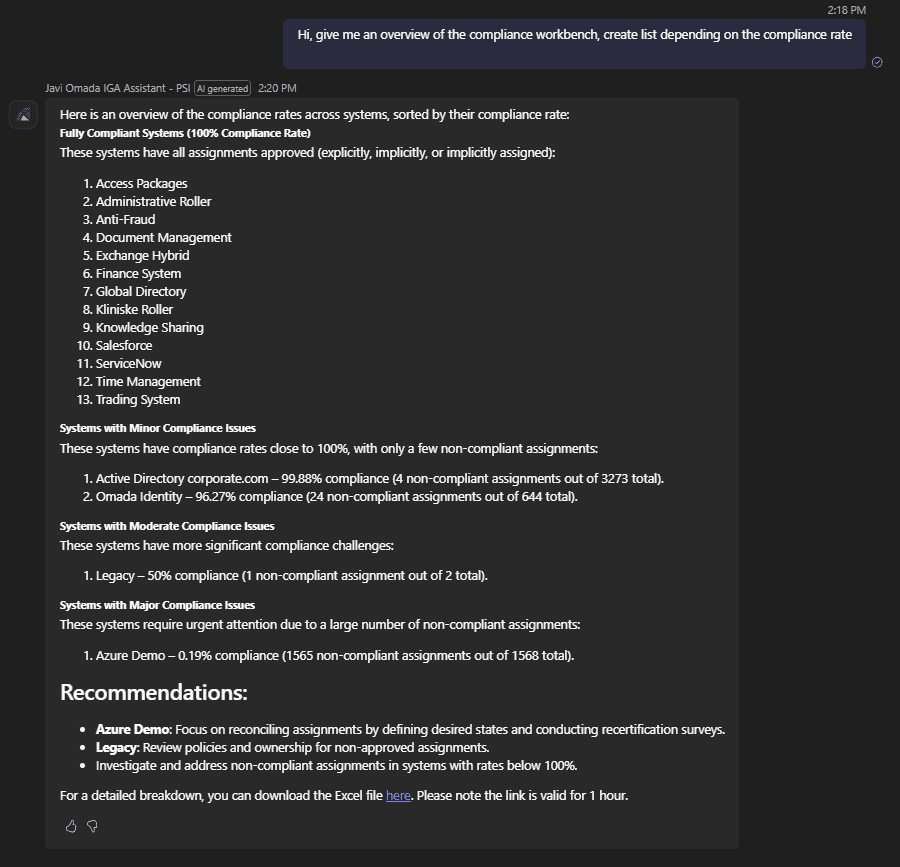
Compliance answers without browsing: Javi can now query Compliance Workbench data on your behalf, returning system compliance overviews, calculated assignment breakdowns, and direct answers to cross-system compliance questions, without navigating multiple pages. For larger result sets, Javi generates a downloadable report.
Richer context for access reviewers: Administrators and resource owners can use the AI Description Optimizer to generate plain-language descriptions of what a resource actually allows. Descriptions draw on related resources, account types, assignment patterns, and risk level, helping reviewers make confident decisions rather than rubber-stamp requests.
Audit-ready reporting: Two new fields – Requester and Resource Status – are now available across the Access Navigator, Audit Trail, and Report Generator dashboards. You can filter and report by who requested each access item, and by whether a resource is Active, Disabled, Obsolete, or Deleted, keeping analysis clean and relevant.
Precise Time-Based Access and a Self-Service Experience
This release tightens control over access duration and completes the move to a consistent, modern self-service interface:
Hours and minutes support for time-limited access: Access requests, extensions, and approvals now let you specify duration at sub-day granularity. Requesters choose between a Time Window (specific start and end dates, with optional exact times) or a Fixed Duration (hours and minutes that begin counting from final approval). The maximum validity policy on resources, folders, and systems supports the same granularity, enforcing precise ceilings without additional tooling.
Eligibility filtering that reflects your full org structure: Resource eligibility now evaluates the complete parent-context hierarchy for each identity, not only explicitly assigned contexts. An identity placed in a child context automatically sees resources associated with all parent contexts above it, particularly valuable for organizations with layered or multi-region structures.
Simplified Platform Administration and Safer Configuration
Three platform improvements give administrators more control with less risk:
Federated login for the Management Portal: The Management Portal now supports sign-in via Microsoft Entra ID, including MFA and SSO, centralizing authentication in your organization’s existing identity provider and closing a compliance gap for the roughly 95% of customers who already use Entra ID as their IdP.

A new Environments Administrator role: Organizations can now separate day-to-day environment management from user administration and authentication configuration. The Environments Administrator role can manage environments and view customer and contract data, but cannot manage portal users or configure identity providers — reducing the risk of overexposed access.
Preview export queries before data moves: A new Preview function in Export Queries & Mappings lets you run export queries and review sample output before data is pushed to Enterprise Server. This aligns with the existing preview capability on the Collector side, catching issues early and reducing rework.